Provider review
Ubigi review
Ubigi is run by Transatel, an NTT company, which makes it the most carrier-like provider in this comparison. It is also one of very few eSIMs supported natively in connected cars and a long list of Windows laptops.
Updated October 2026
- Trustpilot score
- ~4.0 / 5
- Carrier-group backing
- NTT / Transatel
- Native device support
- Cars & laptops
Trustpilot score
Carrier-group backing
Native device support
The bottom line
Our verdict in short
Verdict
Summary
Pros and cons
Pros
- Backed by a real carrier group (NTT/Transatel)
- Native support in connected cars and laptops
- 190+ destinations with stable performance
- Monthly and long-validity plan options
- Reliable, carrier-grade provisioning
Cons
- Mid-market pricing on phone plans
- App and sign-up flow feel dated
- Trustpilot score behind category leaders
- Support tone is telco rather than consumer
Background
Who is behind Ubigi?
Ubigi is the consumer brand of Transatel, a mobile operator owned by NTT. Unlike most eSIM startups, it operates as an actual MVNO with its own core network capabilities.
That is why device manufacturers preload it: it is a carrier relationship, not an app-store listing.
Devices
Cars, laptops and tablets
Many connected cars with built-in eSIM list Ubigi as a data provider, as do a large number of Windows laptops with cellular modems and various tablets.
If you have been searching for a data plan for a device that is not a phone, Ubigi is usually the first name that actually appears in the device's own connectivity menu.
Performance
Coverage and speed
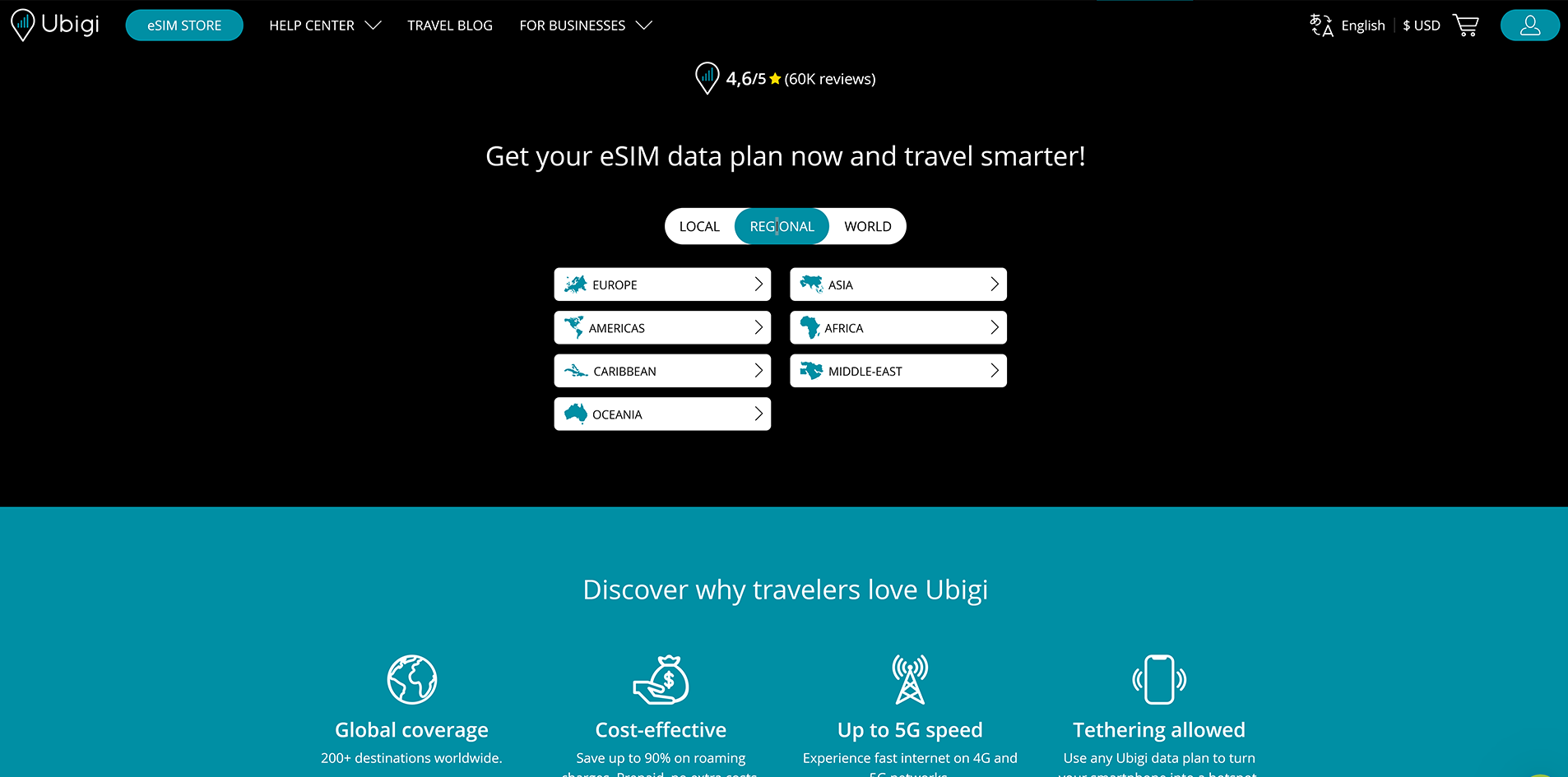
Coverage spans 190+ destinations on 4G/5G partner networks, with the stability you would expect from a carrier-owned operation.
Plans include short trip buckets, monthly recurring options and long-validity data packs.
Pricing
Real plan pricing
| Destination | 1GB | 3GB | 10GB | Monthly plan |
|---|---|---|---|---|
| Europe (regional) | $4 | $10 | $25 | from $17 |
| United States | $5 | $12 | $28 | from $19 |
| Japan | $5 | $12 | $29 | from $19 |
| Global | $9 | $24 | $59 | from $35 |
| In-car data (EU) | — | — | varies | varies |
| Laptop / tablet plans | $5 | $12 | $28 | from $19 |
Figures come from our own tracked pricing and move over time — treat them as a guide to the price band rather than a quote. Always confirm the current price on the provider's own checkout page before buying.
Choosing a plan
What size plan should you choose, and for how long?
| Plan type | Coverage | Best for |
|---|---|---|
| Fixed-data (local) | One country | Standard phone use on a short trip |
| Regional | Europe, Asia, the Americas | Multi-country travel |
| Global | Worldwide coverage on one profile | Frequent international travellers |
| Device plans | Connected cars, Windows laptops, tablets | Non-phone devices with built-in eSIM |
As a rough guide: if your trip is under a week in one country and you mostly need maps, messaging and the occasional map download, a small fixed plan of 3–5GB is usually the cheapest way to buy. If you are unsure how much you will use, or you will be streaming, video calling or tethering a laptop, an unlimited plan costs more upfront but removes the risk of running out mid-trip.
The moment your itinerary crosses into a second country, compare the Ubigi regional price against buying two local plans separately — regional is very often cheaper, and it saves you installing a second profile. Ubigi's real advantage appears when the device is not a phone: if your car, laptop or tablet lists Ubigi natively, buying its plan avoids tethering entirely.
Reputation
Trustpilot and user sentiment
Trustpilot sits around 4.0 — mid-pack. Positive reviews mention reliability and device compatibility; the app and the sign-up flow attract most of the criticism.
Support is available around the clock but feels more like a telco helpdesk than a consumer app chat.
Ubigi's Trustpilot score sits around 4.0, and the reviews split neatly along device lines. Laptop and connected-car owners are the most positive group by a wide margin, because for them Ubigi is often the only option that appears natively in the device's own settings.
Phone-only users are more neutral. The service works, the carrier backing from Transatel and NTT means billing and network stability are dependable, but the pricing is mid-field and the app is utilitarian next to Saily's or Airalo's.
The recurring criticism is the interface and the account flow, which feels more like a telecoms portal than a consumer app. Reviewers rarely complain about the connection itself — the complaints are about the experience of buying and managing it.
Setup
Setup and activation
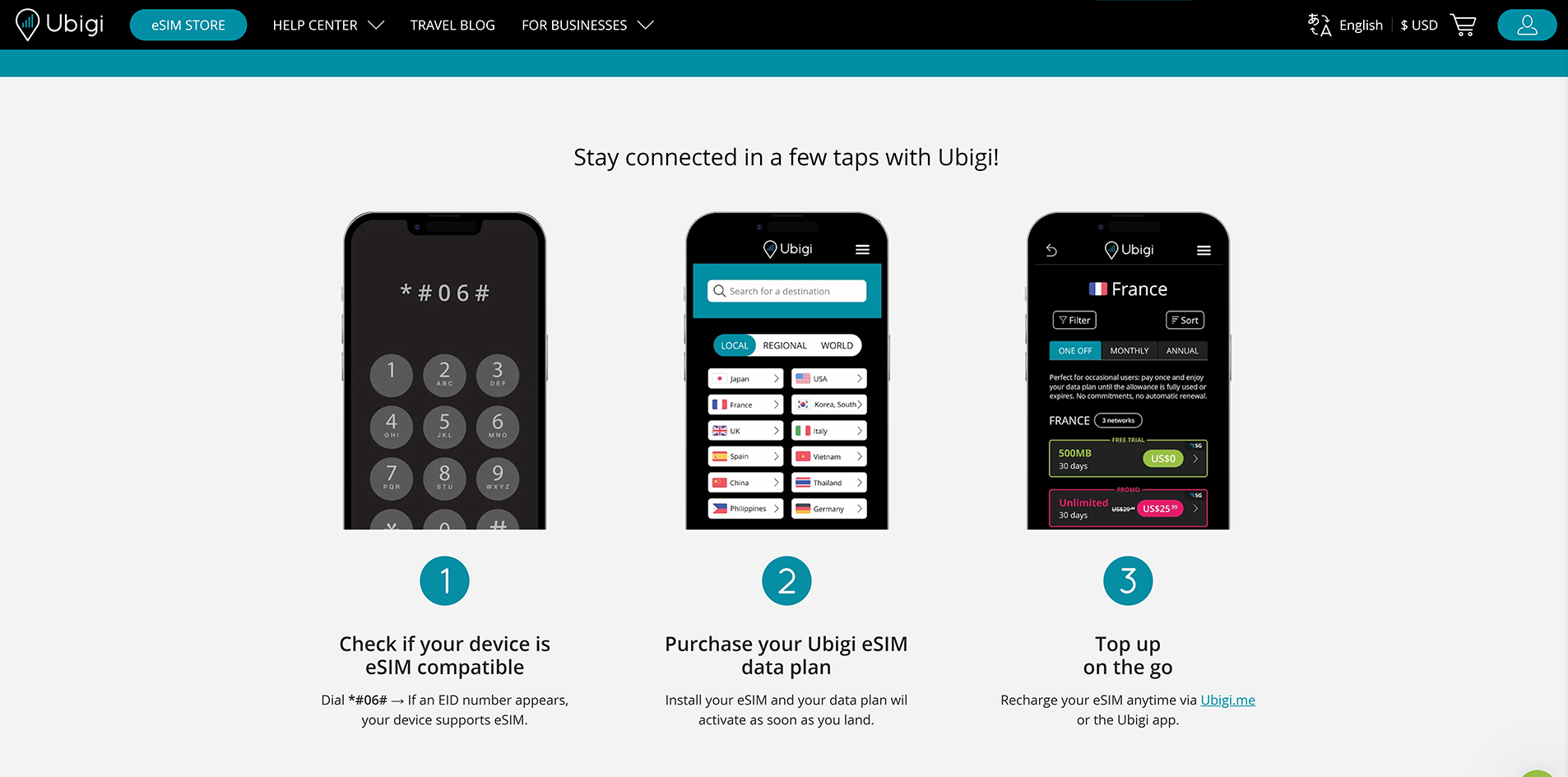
- 1
Check whether your device lists Ubigi natively
Many Windows laptops, tablets and connected cars have Ubigi built into their cellular settings — if so, activate there rather than scanning anything.
- 2
Create an account and buy a plan
Purchase in the Ubigi app or on the website; the plan attaches to your account rather than to a single QR code.
- 3
Install the profile
On a phone: iPhone Settings > Cellular > Add eSIM, or Android Settings > Network & Internet > SIMs > Add eSIM, then scan the code.
- 4
Activate on arrival
Start the plan when you reach the destination; validity runs from first connection.
- 5
Enable data roaming
Turn on Data Roaming for the Ubigi line so it registers on the local partner network.
Support
Customer service
Support is email and ticket-based with published business hours rather than a 24/7 chat desk, which reflects Ubigi's carrier heritage more than a consumer-app mindset.
The upside of that heritage is that escalations reach people who genuinely understand network-level problems — useful when the issue is a device provisioning failure rather than a forgotten roaming toggle.
Ubigi review: FAQs
Final word
The verdict
Ubigi is the pick when the device is not a phone. Native support in connected cars, Windows laptops and tablets means it installs where consumer eSIM brands are simply not listed, and the Transatel/NTT backing brings genuine carrier stability.
Phone plans are perfectly good but mid-priced, and the app is more utilitarian than its rivals.
Our recommendation: choose Ubigi for device breadth and carrier stability, not for the lowest price or the nicest app.
Alternative eSIM Providers
Not convinced? These are the other providers we test and track, with a full review for each.
Voye
Flat rates across 130+ destinations
Voye covers 130+ destinations with instant activation and mostly flat per-country pricing, which makes budgeting a multi-country trip unusually simple.
Read the Voye reviewMaya
Best all-round pick
Maya offers prepaid and unlimited eSIM plans on fast 4G/5G data. Hotspot sharing is supported, which makes it a solid choice for both short city breaks and longer stays.
Read the Maya reviewAiralo
The widest destination catalogue
Airalo is the original travel eSIM and still has the widest single-country selection on the market, with instant activation and a well-rated app.
Read the Airalo reviewSaily
Privacy-first, built by the NordVPN team
Saily is made by the team behind NordVPN and pairs affordable, flexible data plans in 200+ destinations with built-in security features.
Read the Saily reviewJetpac
Best for frequent flyers
Jetpac runs a single eSIM across 200+ destinations on high-speed data, and adds SmartDelay: free airport lounge access when your flight is delayed 60 minutes or more.
Read the Jetpac reviewGigSky
Real at-sea cruise coverage
GigSky is one of the few providers with genuine at-sea coverage, bundling ship and port connectivity into a single cruise plan on top-tier partner networks.
Read the GigSky review
About the Author
Tomer Gips, Digital Nomad & eSIM Reviewer
I'm a digital marketer who travels full-time and tests eSIMs in every country I visit. Every review is based on personal speed testing, verified Trustpilot data, Reddit conversations, and real-world feedback from travelers. I don't accept sponsored content or affiliate bias — just unfiltered, practical reviews for people like you.